
There has been the usual rush of fascinating political books in 2011, including a rash of New Labour memoirs and it’s pretty difficult to narrow a lot of very important books to a list of only five. Alistair Darling’s memoirs certainly stood out amongst the New Labour memoirs and James Macintyre & Mehdi Hassan’s ‘Ed’ gave the first genuine insight into the new Labour leader. There was also a rash of ‘what next for politics’ books, including ‘After The Coalition’ and ‘The Future Of Conservatism’ from the Tory right, ‘the Purple Book’ from the Labour right and the ‘Red Book’ from the Labour left. The fantastically titled ‘Tangled Up In Blue’ tells the story of ‘Blue Labour. Sonia Purnell’s ‘Just Boris’ also gave a very good portrait of the Mayor of London.
2012 is also shaping up to be quite a vintage year for political books and biographies, particularly with Robert Caro’s long awaited fourth volume of the life of LBJ (with a fifth also on the way).
1. Colonel Roosevelt by Edmund Morris
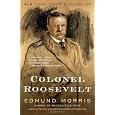
The finale of another great series about another great President. Following on from ‘The Rise Of Theodore Roosevelt’ and ‘Theodore Rex’, this magisterial work takes the Teddy Roosevelt story on from when he left office in 2009. And Roosevelt is unique amongst US Presidents for being as interesting for what he did after leaving office as he is for what he did in office. When Taft succeeded him as President in 2009, Roosevelt quickly believed that his legacy was being squandered. His 2010 Kansas speech launched Roosevelt’s most progressive, radical phase and left him on a collision course with Taft and much of the GOP.
With the speech, he launched one of the most fascinating phases in American politics. Roosevelt joined the Republican primaries for 2012, but he joined them too late and Taft became the GOP nominee. He then formed the Progressive Party, commonly known as Bull Moose, which went on to push the Republicans and Taft into third place. And this book has plenty of contemporary relevance – President Obama gave one of his best speeches for some time in the same town in which Teddy Roosevelt launched his more progressive agenda. Roosevelt used his populist campaign to campaign for the interests of “the people” against “the powerful” – arguing that both the Democrats and the Republicans had become dominated by the interests of big business, rather than the interests of the people. Such a concept has a huge amount of resonance today. Expect Obama to go back to the populist source in this year’s election. This book is a must read about an extraordinary man, whose people versus powerful message can teach us a great deal today.
2. Chavs – The Demonisation of the Working Class by Owen Jones
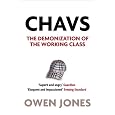
Owen Jones’s work about social class has come in for justified high praise, from the New York Times to Eric Hobsbawm. And the book deserves the high praise. I reviewed ‘Chavs’ back in July and described it back then as:
“a highly readable and very important book. Although, as he suggests himself, Jones is from a middle-class background, he does understand and address many of the big issues facing working class communities. The book correctly addresses the marginalisation of many working class people from political life (just look at turnout figures for lower income social groups as confirmation of this). It has helped to ignite a debate about how to bridge the gulf between Westminster and working class communities and how to best turn round those areas most affected by the blight of unemployment and deindustrialisation.”
For too long, it has suited both left and right to ignore class and to ignore the crucial issues around class. As politics has become more professional and more and more middle class, working class concerns have fewer voices in the upper echelons. Jones has helped ensure that a new debate has been created on the subject. It’s a lively and very good book and, whether you agree with Owen Jones’s politics or not (as I pointed out when I reviewed it, Chavs is more pointing out problems than suggesting solutions), it is well worth a read.
3. Adapt by Tim Harford
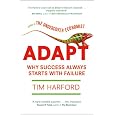
Not strictly a political book but a book that is having a real political impact. In this book, Harford extols the virtues of experimentation, of risk-taking and, crucially, failure. As the book’s subtitle suggests, success always starts with failure. Tim Harford also spoke about the book at Policy Exchange and I blogged about the event here. The importance of his ideas are multiple. Namely, that local trial and error are good things and we shouldn’t expect a monopoly of wisdom from central government or anywhere else. Equally, prizes could be a particularly effective way of bringing about innovation.
4. You Can’t Say That by Ken Livingstone
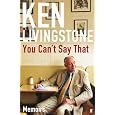
There are few more interesting politicians than ‘Red Ken’. Lovingly described as “the most odious man in Britain” by The Sun, Livingstone emerged from battles with Thatcher’s Government, the law Lords and Tony Blair and ongoing battles with the Evening Standard to become the first elected Mayor of London. Ken is one of the lone survivors of the politics of the 1980s and has quite a tale to tell. And he tells the tale in some detail. It’s open to question whether we need to hear the near verbatim diary of his hitchhiking trip to Africa as a young man or plenty of internal Labour of GLC committee meetings in the 1970s. Having said that, there are some great sparks and some great humour in this book which is much more compelling than most examples of the genre.
Ken is a marmite politician (I find, amongst other things, the links with Chavez pretty distasteful). But controversial, marmite politicians are good in an age of soundbites. You may not agree with what he says, but you have to respect the fact that he’s one of the few genuinely working class politicians at the front line today and you have to respect that the support for gay and ethnic minority communities for which he was lambasted in the 1980s has now become mainstream. A politician who provokes strong emotions on both sides, his autobiography is a worthwhile read for anybody interested in British politics of recent decades.
5. Tory Pride and Prejudice by Michael McManus
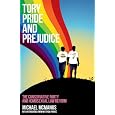
It’s only a decade or so since front bench Conservatives were openly supporting Section 28 and others were using offensive language about reducing the age of consent and other key issues. In only a few years, the Tory Party changed from being a party portrayed as being anti gay to being the party with more openly gay MPs than any other. It’s a pretty radical and hugely welcome change, accompanied by a much needed mea culpa or two along the way. This fascinating book charts the attitude of the Conservatives towards homosexual law reform from the crackdown in the 1950s through to the welcome approach of this Government, with its support for gay marriage (which was announced shortly after the book went to print). There’s some great anecdotes here as well – the book is a fascinating illustration of the changing nature of the Tory Party and the changing nature of society (very much for the better).
@timharford @owenjones84 @torypride all feature in @Platform10 best political books of 2011 http://t.co/tWdlmCZ4
New blogpost: The Best Political Books of 2011 http://t.co/bTBejr2v
RT @DJSkelton: @timharford @owenjones84 @torypride all feature in @Platform10 best political books of 2011 http://t.co/tWdlmCZ4
RT @DJSkelton: @timharford @owenjones84 @torypride all feature in @Platform10 best political books of 2011 http://t.co/tWdlmCZ4
RT @PlatformTen New blogpost: The Best Political Books of 2011 http://t.co/2kIu9lZC
Very chuffed about this recommendation for me book – http://t.co/w8sOZe99